35. Phew! What a scorcher!
Updated: Jul 16
I wrote in Blogpost 26 that I was looking forward to the next heatwave and seeing if I could manage overheating in the EcoBungalow better. This last week has been extreme, with record temperatures recorded across Europe. How has the EcoBungalow performed?
The short answer is: I feel it does better at keeping the house warm in winter than keeping it cool in summer.
During the design stage, the EcoBungalow was assessed using the Passive House Planning Package (PHPP). The PHPP predicted that the interior of the EcoBungalow would overheat (i.e. exceed 25ºC) for up to 1% of annual hours. This is well below the Passivhaus limit of a maximum of 10%. Up to 1% is around 88 hours a year. This week, during the heatwave, the interior of the EcoBungalow has been over 25ºC for 71 hours. So it won’t take much to exceed the PHPP’s prediction in 2026. Crunching the numbers for 2025, shows that the interior overheated for 1.85% of the year.

At design stage, we discussed whether to incorporate active cooling into the build. There are two ways we could have done this:
Mechanical Ventilation: The EcoBungalow is constantly supplied with filtered fresh air via the Zehnder ComfoAir Q350 Mechanical Ventilation with Heat Recovery (MVHR) unit. It’s possible to bolt-on an additional module to provide cooling (and heating) via the MVHR ductwork. This module, the ComfoClime 24, retails at around £3,700.
Air Source Heat Pump: It’s possible to use the ASHP to actively cool a building as well as heating it, using a reversing valve to run in cooling mode. However, the EcoBungalow uses traditional radiators in combination with the ASHP and these are not very effective in cooling a building. Better to have an underfloor system or fan coil units. Designing an active cooling system using the ASHP would have added significant cost to the build.
Given (i) the prediction of a low level of overheating; and (ii) the limitations of the budget, we decided not to include active cooling.
Like all houses in a heatwave, actively trying to prevent the house overheating in the first place is the key to keeping temperatures as low as possible. So this means simple steps of:
keeping the sun out (drawing blinds and curtains); and
‘purge’ ventilating at those times of day when the outside temperature is lower than inside (opening windows early morning and late evening to achieve cross ventilation). However, the temperatures have climbed so high this week that ‘purge’ ventilation has had a limited effect.
There are two things we could have done to make the EcoBungalow work better in hot weather:
more openable windows in the living area; and
external solar shading, particularly on the large west-facing living room windows which have the most significant solar gain.

Openable windows: I hadn’t appreciated the limited ability of the MVHR to cool the house overnight when the house has overheated during the day. The steady, gentle trickle of fresh air tends to cool the internal temperature by only one or two degrees during the night. For a really significant impact on daytime overheating. ‘purge’ ventilation is needed in the morning and late evening. This is very effective when the front door and back door are opened, with excellent cross ventilation typically achieving around a 2-4ºC drop in temperature within 30 minutes or so. Ideally – when it’s been really hot – leaving windows open overnight would further cool the interior. However, for security reasons, these doors can’t be left open overnight. So the living space has just one window that can be left open overnight – not enough for cross ventilation. In retrospect, making the large west facing window openable would have given improved ventilation overnight. A simple solution may be an American-style fly-screen to the back door along with some additional security so that this can be left open.
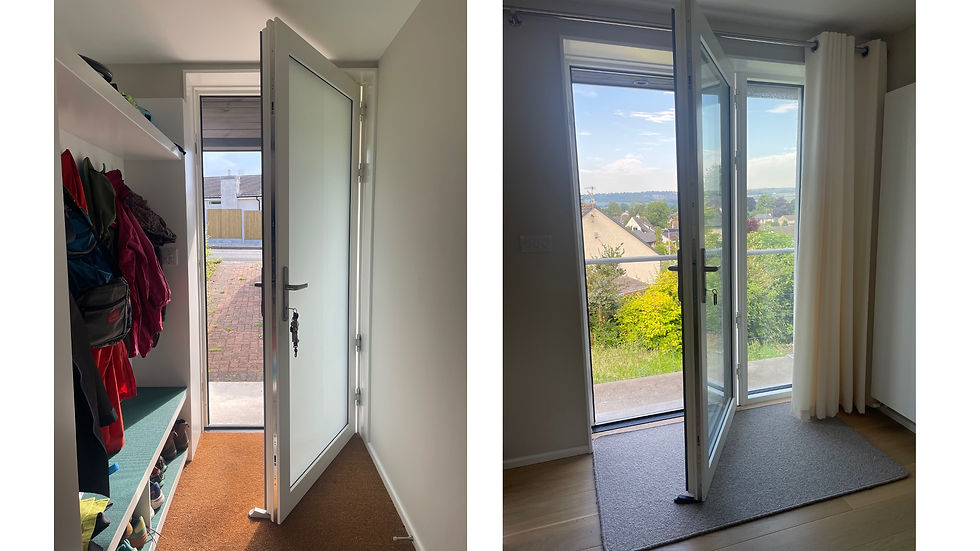
External solar shading: Whilst we can’t do much about openable windows in the living room, it is possible to introduce some external shading, especially to the large floor-to-ceiling living room windows. External shading can reduce solar gain by between 80 and 100%, whereas even the most effective internal shading will only reduce solar gain by 40% at most. More here in a useful PassivHaus Trust article:
There’s lots to think about – not only what external shading is likely to be most effective, but also what will look good, be easy to operate and give most bang per buck. A permanent solution won’t be quick.

Sadly, neighbours to both the east and west have recently cut down large trees. There’s a noticeable decrease in the amount of shade to the EcoBungalow at the beginning and end of the day. So – in addition to solar shading - a (very!) long-term strategy may be waiting for the fruit trees in the front garden to grow and planting at least one new tree in the west-facing back garden.
In summary, the lessons I learned about active management through shading and purge ventilation help but - with this week's extreme temperatures - isn't enough to prevent overheating.


Comments