34. EcoBungalow Retrofit: Geeky stats for 2025

Warning: this blogpost contains a lot of geeky detail! Like all Air Source Heat Pumps, the Viessmann has an app to control it and provide feedback. It has a very handy annual analysis of energy use and thermal energy generation. Lots of lovely detail that means we can delve into how much energy is used to heat the EcoBungalow and provide hot water, how much this costs, and how it relates to the design-stage calculations in the Passive House Planning Package (PHPP).
Energy use
The ASHP unit consumed a total of 1.02 MWh of electricity in 2025, generating 6.17 MWh of thermal energy. That’s impressive efficiency of 5.9. (Bear in mind that anything over 3 is considered ‘good’). This table gives a detailed breakdown:

The Octopus Energy bills from 2025 show an overall usage of 2828.5Kwh. So the ASHP consumed about 36% of the total amount of energy used by the EcoBungalow. The rest is appliances (cooker, fridge, washing machine, laptop etc) along with lighting and the Mechanical Ventilation system.
Energy Costs
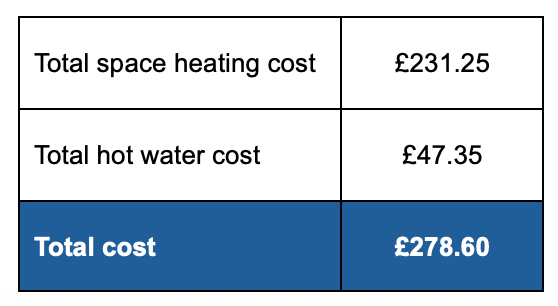
The EcoBungalow operates on Octopus Energy’s ‘Cosy Octopus’ tariff, with different rates at different times of the day. The total bill for 2025, including VAT and the Standing Charge, was £835.09. Hot water is only ever heated during the periods of the lowest tariff (6am and 3pm) and this averaged 12.04p per kWh. In contrast, the space heating is operational all the time. The average tariff has been 22.9p per kWh. Using these figures, we get totals for heating and hot water, including VAT and a proportion of the Standing Charge:
Comparison with PHPP Space Heating Prediction
At the start of the project, we agreed a brief that would aim for AECB Level 2 retrofit standard as a minimum, with an aspiration to meet EnerPHit where possible. We knew that there would be diminishing returns on investment for meeting EnerPHit insulation standards, and did not expect to meet its requirement for a maximum space heating demand of 25 kW/m2. The Passive House Planning Package (PHPP) calculated a space heating demand of 38 kWh/m2 and an airtightness of 1 ACH. In the event, we far exceeded the airtightness with an extraordinary result of 0.2 ACH. However, the actual space heating demand is 49 kWh/m2 – significantly above the predicted level, and only just meeting the AECB requirement for a maximum of 50kWh/m2.
So why is the space heating demand so much higher than predicted in the PHPP?
There are probably three reasons:
For a retrofit project, there will be a small margin of error as not all elements of the build that impact on heat loss can be predicted at design stage. However, this margin would not account for the entire increase in space heating demand.
The PHPP is based on the assumption that the EcoBungalow is normally occupied by an average of 2.4 people. It’s overwhelmingly occupied by just me – and I generate a lot less heat than 2.4 people!
I’m away a lot: climbing, walking, skiing and visiting friends and family. Unusual circumstances meant that during 2025 I spent even more time away: around one third of the year, often in very short bursts of just a couple of nights away. That’s a lot of time for the EcoBungalow to have no heat generation from cooking, working on the computer and so on.
Although the space heating demand is higher than anticipated, it is still significantly lower than the original bungalow. The original building had an estimated space heating demand of 200kWh/m2, so the demand is reduced by 75%, with correspondingly lower bills for a consistent and comfortable temperature of 20.5 degC.


Comments